
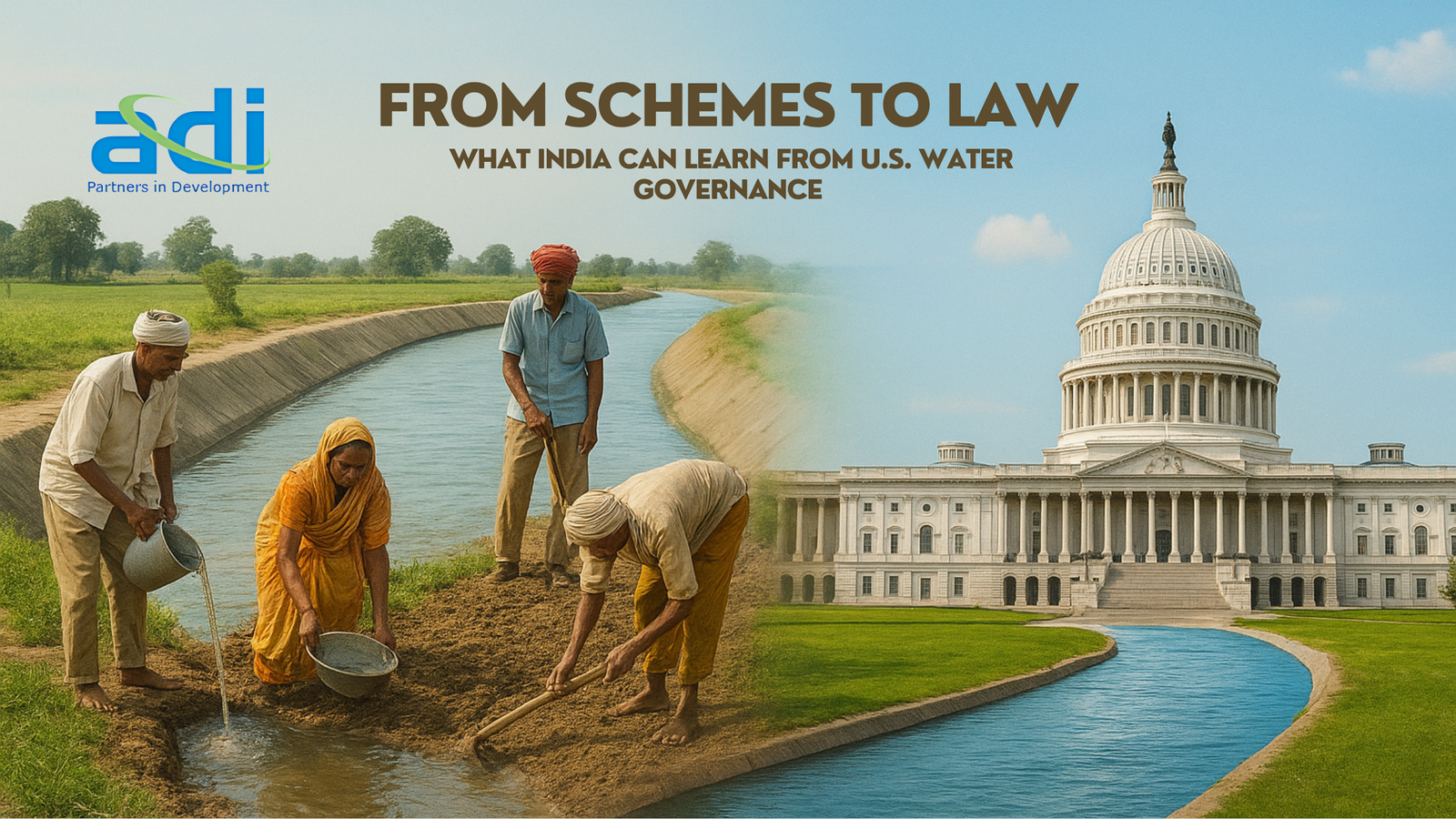
Can meaningful insights emerge by comparing how a developing Nation like India and a developed Nation like the United States govern their water systems? Learnings from U.S. water governance, combined with India’s current legal and institutional landscape, may help chart a path toward a more holistic and results-focused water law framework. The idea isn’t to replicate but to reflect, to understand how U.S. history shaped its water laws, where India stands on that trajectory, and why a comprehensive, implementable national water law might now be essential. This blog intends to explore how such a comparative reflection can inform India’s future water policy thinking and underscores that this exercise is meant to be thought provoking, encouraging dialogue rather than prescribing a definitive model.
India’s Legal Landscape: A Patchwork of Policies and Acts
India’s legal path around water has been quite different. Water governance here is largely a State subject under Entry 17 of the State List in the Constitution, while the Union can legislate on interstate rivers and river valleys under Entry 56 of the Union List. This division often results in fragmented governance and overlapping jurisdictions.
India’s key central laws governing freshwater systems include:
- Water (Prevention and Control of Pollution) Act, 1974 – The cornerstone legislation for water quality regulation, establishing the Central and State Pollution Control Boards.
- Inter-State Water Disputes Act, 1956 – Provides mechanisms for adjudicating water sharing disputes between states.
- River Boards Act, 1956 – Intended to promote integrated river basin planning, though rarely operationalized.
- Environment (Protection) Act, 1986 – Empowers the government to address pollution and protect ecosystems.
- Groundwater Regulation Acts – Enacted individually by states such as Maharashtra (2009), Kerala (2002), and Andhra Pradesh (1996).
- National Water Policy, 2012 – A non-binding framework advocating integrated and sustainable water management.
The Water Act of 1974 did set up important institutions like the Pollution Control Boards, but its effectiveness has been mixed. Groundwater, India’s lifeline, remains only partially regulated, and the National Water Policy remains more advisory than enforceable.
Implementation is often the Achilles’ heel – enforcement is weak, coordination across states is limited, and data monitoring often lags behind reality. The U.S. has its own challenges, particularly with non-point source pollution, but its federal framework provides a unified baseline that India still lacks.
India’s Flagship Missions: Proof of National Coordination at Scale
India stands at a pivotal moment in its water journey. Despite remarkable progress through national missions such as Namami Gange and Jal Jeevan Mission, the country’s water governance framework remains fragmented and uneven across states. This comparison aims to identify lessons that can help India shape a more integrated policy framework—one that represents Indian values of community stewardship, sustainability, and equity, while drawing on global best practices in law and governance.
Namami Gange Programme (2014)
The Namami Gange Mission, launched as the National Mission for Clean Ganga, demonstrates India’s ability to coordinate at a national scale. It takes a river basin approach, integrating pollution control, sewage treatment, industrial effluent management, riverfront development, and biodiversity protection. Backed by strong central funding and multi-state coordination, Namami Gange shows that India can operationalize basin-level management when river health is prioritized.
Jal Jeevan Mission (Har Ghar Jal, 2019)
The Jal Jeevan Mission (JJM) has redefined rural drinking water governance. Moving household tap water coverage from a small base to most rural households, JJM exemplifies service delivery through federal-state collaboration, continuous monitoring, and clear accountability. It treats water as a guaranteed service, not just an infrastructure asset. Together, these two programmes demonstrate that India has the institutional capacity and financial architecture to deliver large-scale, coordinated water outcomes, the same building blocks required for a comprehensive national framework law.
The U.S. Experience: Building a Federal Backbone for Water Governance
The U.S. journey toward strong water protection began more than a century ago, with the Rivers and Harbors Act of 1899, which focused primarily on navigation and commerce. As industrial growth intensified in the early 20th century, rivers and lakes suffered heavy pollution, culminating in visible crises like the Cuyahoga River fires of the 1950s and 1960s and the contamination of Lake Erie. These events, amplified by the environmental movement of the 1960s and mounting public outrage, became the catalyst for comprehensive reform. In response, Congress established the Environmental Protection Agency (EPA) in 1970, setting the stage for the landmark Clean Water Act (CWA) of 1972.
The CWA represented a turning point and a pragmatic balance of incentives and regulation— a true model of ‘carrots and sticks.’ It offered substantial federal grants to municipalities for wastewater treatment (the carrots) while imposing strict discharge permits and penalties for polluters (the sticks). Though critics have called it bureaucratic and costly, it remains one of the most successful frameworks for reducing point-source pollution and restoring U.S. waterways.
Subsequent legislation, including the Safe Drinking Water Act (1974) and amendments that strengthened wetlands protection and infrastructure financing, built upon this foundation. The American approach evolved from protecting waterways for navigation to safeguarding them for ecological integrity and public health, anchored in strong federal oversight, scientific monitoring, and transparent implementation. This coherent legislative framework ensured consistency across jurisdictions, promoted data transparency, and allowed water governance to endure beyond political cycles.
The U.S. journey toward strong water protection began more than a century ago, starting with navigation and commerce concerns under the Rivers and Harbors Act of 1899. It wasn’t until the mid-20th century that pollution became the focal point, leading to the landmark Clean Water Act of 1972. This act marked a turning point, it created a nationwide system for regulating pollutant discharges into surface waters and established federal-state cooperation through the Environmental Protection Agency (EPA) and state agencies.
Over time, other laws such as the Safe Drinking Water Act (1974) and subsequent amendments addressing wetlands, wastewater treatment, and infrastructure made the framework more robust. The American approach, therefore, evolved from protecting waterways for navigation to safeguarding them for ecological and public health reasons—built on strong federal oversight, scientific monitoring, and transparent implementation. This model demonstrates that coherent legislation can enable consistency across jurisdictions, foster transparent data systems, and ensure the continuity of water governance beyond political cycles.
From Schemes to Law: Charting India’s Next Water Frontier
India does not lack ambition or scale. Namami Gange and Jal Jeevan Mission prove that when water is treated as a national priority, the Union government can coordinate across states, finance large infrastructure, and enforce performance standards. Yet, constitutionally, water remains a State subject, resulting in fragmented governance. Surface water quality, groundwater extraction, pollution control, and even rural water supply are managed through a mix of state laws, central schemes, and temporary missions rather than a cohesive framework. In contrast, the U.S. experience under the Clean Water Act and Safe Drinking Water Act illustrates how a federal legal backbone can unify diverse efforts, ensuring accountability, consistent data systems, and continuity across political cycles. The next step for India is not more schemes but a comprehensive national water law that:
- Clearly defines centre–state roles in water governance.
- Establishes minimum service and quality standards for drinking water and freshwater systems.
- Integrates surface and groundwater management.
- Ensures data transparency, citizen participation, and accountability.
Such a law would transform India’s water governance from time-bound schemes into a permanent legal commitment making sustainability, equity, and resilience a legal obligation rather than a policy aspiration.
Conclusion
India’s story in water management is one of transition. The tools, programmes, and institutional frameworks already exist. What remains is to weave them together into a unified, enforceable framework that reflects India’s values of community-led management and ecological stewardship.
The U.S. example shows how legal architecture can create lasting accountability. For India, based on a national water framework can do the same, anchoring today’s momentum in durable legal and institutional strength. By elevating water governance from schemes to statute, India can ensure that every citizen, community, and ecosystem has access to safe, sustainable, and equitable water systems for generations to come.