
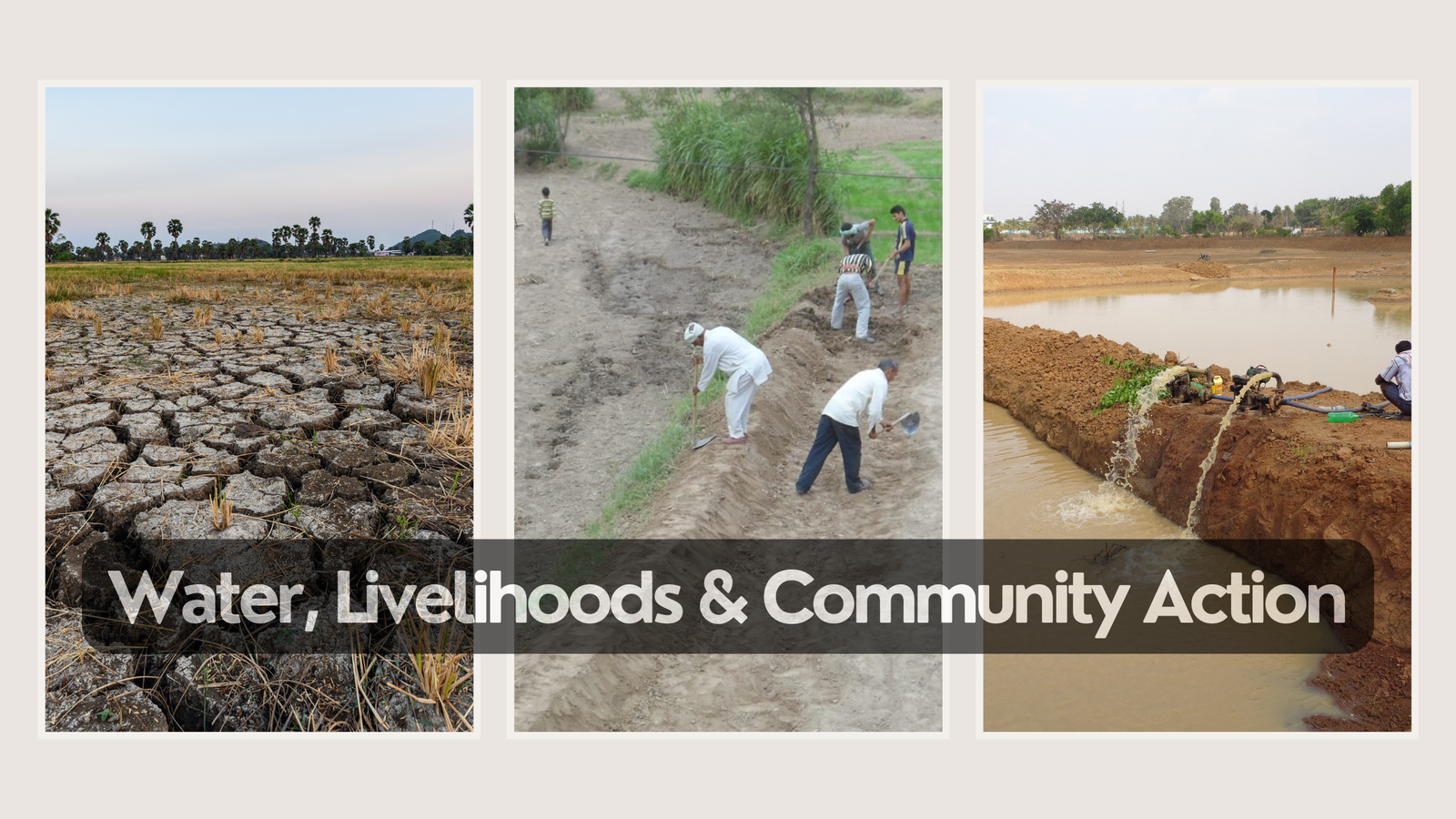
Water decides the future of rural livelihoods.
India is experiencing the growing impacts of climate change, with heatwaves becoming more frequent and intense across both urban and rural regions. While rising temperatures often dominate the conversation, water stress has emerged as an equally pressing challenge. In many parts of rural India, the issue is not only inadequate rainfall but the inability to retain and recharge the water that does arrive. Short periods of heavy rainfall are often followed by prolonged dry spells, causing rainwater to run off before it can replenish groundwater reserves. Over time, silted ponds, degraded water bodies, weakened drainage systems and excessive groundwater extraction have further reduced the natural capacity of landscapes to store water. These changes are reflected in declining water tables, reduced irrigation availability, lower agricultural productivity and growing uncertainty for small and marginal farmers whose livelihoods depend heavily on the monsoon.
For rural families, the impact goes beyond water scarcity. Heat waves affect crop yields, livestock health, household incomes and food security. Women and children often travel longer distances to access water, while farmers struggle with rising cultivation risks and uncertain growing seasons. As climate change intensifies, the need for sustainable and community-led water management has become more urgent than ever.
For a farming household, water is not only about drinking or irrigation. It determines whether a farmer can take a second crop, whether livestock can be sustained, whether soil remains productive, whether migration can be reduced, and whether a village can face a dry year with confidence.
This is why sustainable water resource management is central to rural development. It creates work, strengthens agriculture, supports allied livelihoods, and helps communities become more resilient to climate change.
For Alternative Development Initiatives (ADI), water has always been linked with people, livelihoods and institutions. ADI’s philosophy is rooted in the idea that development must value people’s inherent potential to lead change. The organisation works as a development support institution, combining professional competence with social commitment, and supporting communities to manage their own development processes.
Water as a Livelihood Enabler
In rural India, the link between water and livelihood is direct.
When ponds are rejuvenated, rainwater is conserved, groundwater is recharged, and soil moisture improves, the impact is visible in the everyday lives of people. Farmers can cultivate more reliably. Cropping risks reduce. Livestock receives better support. Kitchen gardens, nurseries, fisheries, dairy and other local livelihood activities become more viable. ADI’s watershed and water resource work follows this integrated understanding. The
organisation has worked across more than 20 states in India on water resource management, natural resource management, livelihood promotion, agriculture development, community empowerment and institutional development.
Through its Sustainable Water Resource Development & Management initiatives, ADI has supported water conservation, recharge and replenishment efforts across states such as Maharashtra, Telangana, Karnataka, Tamil Nadu, Andhra Pradesh, Kerala, Haryana and Punjab. These initiatives have benefited around 90,000 people and created the potential to recharge more than 7,000 million litres of water annually.
This work is not limited to creating water structures. It is about creating conditions for livelihoods to grow.
Watershed works such as check dams, farm ponds, contour trenches, loose boulder structures, pond rejuvenation, rainwater harvesting and recharge measures generate local employment during implementation. Over time, they strengthen the local economy by improving agricultural productivity, reducing uncertainty, and supporting small rural enterprises linked to land and water.
In climate-stressed regions, this becomes even more important. Erratic rainfall, declining groundwater and prolonged dry spells are already affecting rural families. Sustainable water management helps communities store rainwater, reduce runoff, improve soil health and prepare better for uncertain seasons.
Water security gives people the confidence to invest in their land, their livestock and their future.
ADI’s Work in Sustainable Water Resource Management
ADI has worked with government agencies, corporate partners, donors and communities to evolve practical and scalable water solutions.
In partnership with PepsiCo India, ADI evolved macro and micro-level Sustainable Water Resource Development & Management strategies around 33 plants and surrounding communities. The work focused on conserving and replenishing water, creating positive water balance, and supporting livelihoods. ADI’s partnership with PepsiCo has benefited around 70,000 people and created potential to recharge more than 6,000 million litres of water every year.
ADI has also worked on wastewater management in Punjab, including initiatives at Bijalpur, Bhawanigarh in Sangrur district and Icchewal, Nabha in Patiala district. These efforts focused on rejuvenating wastewater ponds through cost-effective and indigenous biotechnology-based techniques, recycling treated water for irrigation, and creating rainwater ponds for aquifer recharge.
In Haryana, ADI evolved a wastewater management strategy to manage 600 ponds in Jind district. The strategy focused on cleaning and remodelling village ponds, improving rural water and sanitation, enabling groundwater recharge, and strengthening livelihoods through better use of land and water resources.
These examples reflect ADI’s approach clearly: water management must serve people, strengthen local livelihoods and remain rooted in the ecological reality of the area.
Community Participation: The Core of Watershed Development
Watershed development succeeds when communities lead it.
ADI believes that people are not passive beneficiaries of development. They are partners, planners, implementers and custodians. This belief shapes ADI’s work across participatory planning, micro-planning, capacity building, institution building and community-led management.
In watershed development, community participation is not an additional activity. It is the foundation.
Water is a shared resource. A pond, check dam, recharge structure or plantation effort benefits the wider community. Its success depends on how people use it, maintain it and protect it. When communities participate from the beginning, they understand the purpose of the intervention, contribute local knowledge, and develop ownership over the assets created. ADI has designed, developed and provided micro-planning and capacity-building support to more than 50 watersheds covering more than 50,000 hectares of land through donor, bilateral, state and central government-supported projects.
Under the Watershed Development Fund of NABARD in Una, Himachal Pradesh, ADI facilitated the implementation of a watershed programme covering 2,000 hectares. More than 300 Farmer Clubs and Self-Help Groups were formed in the district. These local institutions are important because they help communities organise, participate, maintain assets and continue development efforts beyond the project period.
ADI has also worked on participatory rural appraisal, micro-planning, training, watershed management, eco-restoration, natural resource management, community empowerment and institutional development. This strengthens the ability of communities to understand their resources, make informed decisions and manage created assets.
Collective Action Creates Lasting Success
A watershed is not only a geographical unit. It is a social unit as well.
The land, water, vegetation, farms, common areas and settlements within a watershed are connected. What happens upstream affects those downstream. How water is harvested, used and shared affects the entire village. This makes collective action essential.
When communities come together, watershed development moves beyond construction. It becomes a shared process of planning, contribution, maintenance and learning. ADI’s work has shown that collective action can help villages conserve water, recharge groundwater, reduce soil erosion, improve agriculture and create livelihood opportunities. It also builds cooperation and trust. People begin to see water not as an individual asset but as a community responsibility
This is especially important in the context of climate change. Rural communities are facing greater uncertainty, but communities that are organised are better able to adapt. They can plan for dry spells, protect common resources, maintain water structures, and support each other during difficult seasons.
Community participation also creates local employment. People are engaged in watershed construction, pond work, plantation, soil conservation, maintenance and other natural resource activities. Improved water availability then supports farming, livestock, kitchen gardens and other income-generating activities.
The result is not only ecological improvement. It is social and economic resilience.
Institutions Make Development Sustainable
For ADI, institution building is central to development.
Water structures need maintenance. Community assets need management. Benefits need to be shared fairly. Local plans need continuity. These responsibilities cannot depend only on external agencies.
This is why ADI works to strengthen community-based organisations, Farmer Clubs, SelfHelp Groups, Panchayats, local institutions and learning networks. The aim is to build local capacity so that communities can manage development processes with confidence. ADI’s philosophy of “Field University” reflects this belief. The field is not only a place of implementation. It is a place of learning. Communities, field workers, professionals, institutions and partners learn from each other, refine approaches, and build practical solutions suited to local realities.
This approach makes development more grounded and more durable.
Water Security is Rural Resilience
Sustainable water resource management creates a chain of change.
- It conserves water.
- It improves soil.
- It strengthens agriculture.
- It creates employment.
- It supports allied livelihoods.
- It reduces vulnerability.
- It builds confidence.
- It prepares communities for climate change.
ADI’s work in India reflects this chain. By linking water resource management with livelihood promotion, community empowerment and institutional development, ADI has shown that watershed development is not only about treating land and water. It is about strengthening people’s ability to shape their future.
The future of rural development depends on such integrated approaches. Climate change will continue to test rural communities. Water stress will continue to influence agriculture and livelihoods. But when communities are organised, institutions are strong, and water is managed sustainably, villages are better prepared to face change.
Water is a livelihood enabler.
Community participation is the force that makes it last.
Together, they form the foundation of climate-resilient rural development.